How people find their way through change together
There are four interconnected kinds of work that help people navigate consequential change together.
When a team, organization, or community faces consequential change, it needs more than a destination and a list of actions.
It needs a way to prepare for the work, understand the reality it is navigating, establish shared direction, and continue making responsible moves as circumstances unfold.
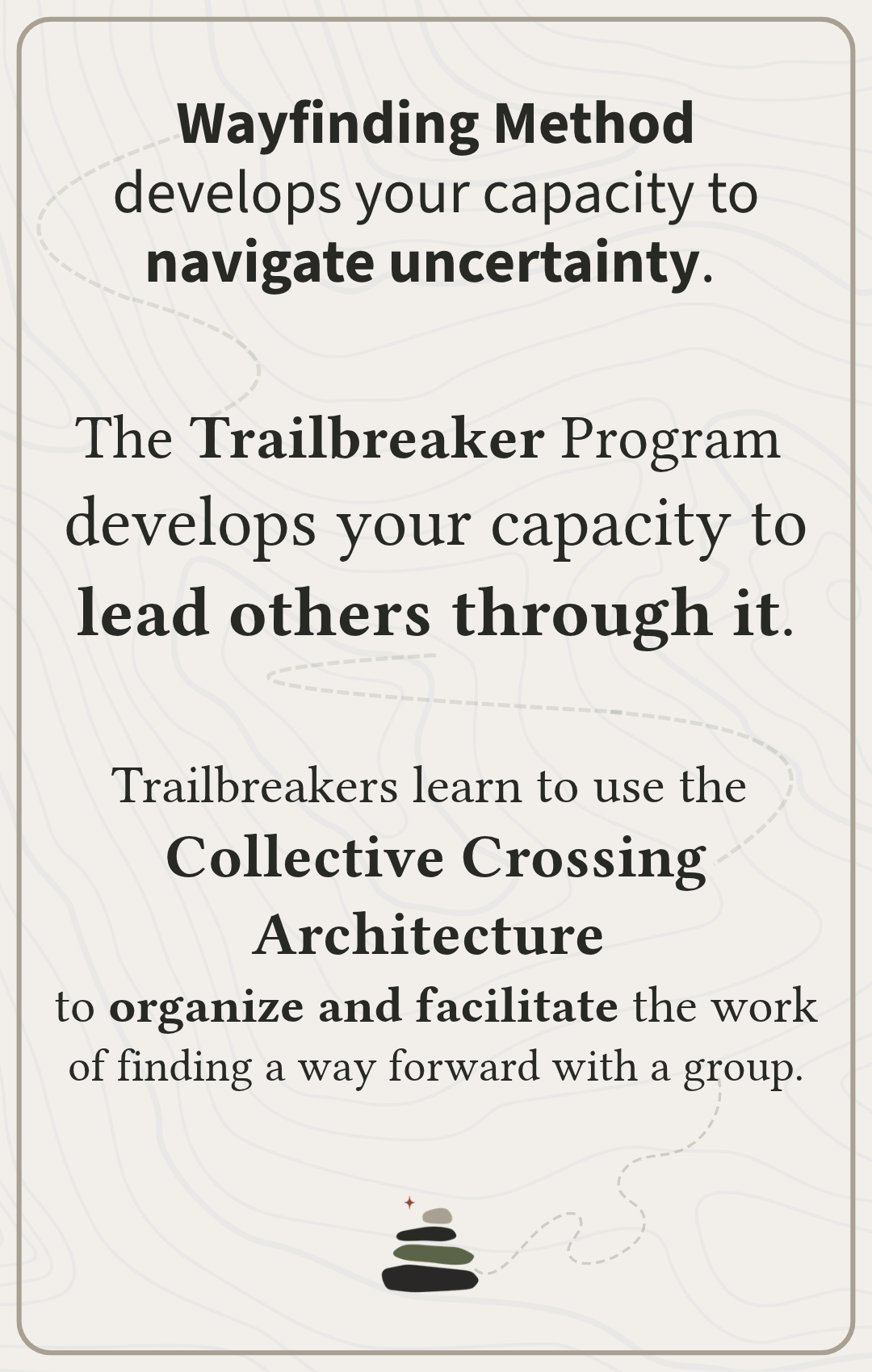
This is the purpose of the Collective Crossing Architecture: Wayfinding School's framework for organizing the work of finding a way forward together.
What makes a crossing consequential?
A crossing is movement beyond what is—or what has been—toward a future that has yet to take shape. It may begin with disruption, difficulty, an ending, or an opportunity worth pursuing.
A crossing becomes consequential when both the future people are moving toward and the way they get there matter.
Consider an organization reimagining how it serves its community, a leadership team responding to changing circumstances, or a group pursuing an ambitious new direction.
The work isn't simply to decide what should happen next. It's to enable people to participate in shaping that future and develop the collective capacity to navigate toward it.
Four interconnected kinds of work
The Collective Crossing Architecture organizes this work into four phases. Each addresses a distinct responsibility and a fundamental question.
01 / Prepare the Crossing
Who is making this crossing together?
Before establishing direction, a collective needs to create the conditions for meaningful participation.
Who is affected? Whose perspectives are needed? Who has authority to make which decisions? Who will facilitate? What agreements will help people work together responsibly?
Preparing the crossing isn't simply scheduling a retreat or assembling a planning team. It's establishing the human and practical conditions that make collective work possible.
02 / Establish Location
Where are we, really?
People may agree that change is necessary while holding very different understandings of their present reality. Establishing location means bringing relevant information and perspectives into view, examining assumptions, and noticing what is stable, changing, ending, or emerging.
The aim isn't perfect certainty or agreement about everything. It's sufficient shared understanding to make responsible choices about what comes next.
Sometimes this work reveals that the question a group began with isn't the question it actually needs to answer.
03 / Form Orientation
What future are we moving toward?
With a grounded understanding of the current state, the collective can explore possibilities and make choices about its future state.
What matters enough to pursue? What outcomes would represent meaningful progress? Where should attention and effort be focused?
This work produces a Crossing Map: a shared articulation of the future the collective intends to pursue, its strategic bearings, meaningful outcomes, and enough of an initial route to begin moving.
The Map may include familiar elements of a strategic plan. But its purpose is orientation—not the illusion of knowing every turn ahead. [Read more about how traditional strategic plans fit here.]
04 / Navigate the Crossing
How will we keep finding our way as we move?
A direction becomes consequential through participation and action (aka, getting to work). The collective needs practical ways to coordinate work, make decisions, notice changing conditions, learn from experience, and adjust its course.
This work establishes a Crossing System: the roles, agreements, structures, information flows, and rhythms that support ongoing navigation.
A Crossing System matters because a plan cannot respond to reality on its own. People need a way to keep finding their way as circumstances unfold.
An architecture, not a script
These four phases are interconnected. They aren't four boxes to check or a sequence to complete once and leave behind.
Preparing a crossing may reveal new information about the present. Establishing location may change who needs to participate. Early action may challenge assumptions and require the collective to revisit its direction.
The architecture helps people recognize what kind of work needs attention. It doesn't replace their responsibility to notice, judge, decide, participate, and learn.
Within and across all four phases, the Wayfinding Method provides a recurring practice for navigating uncertainty: Perceive → Locate → Form Orientation → Participate Responsibly → Learn With Reality → Perceive Again.
The architecture organizes the collective crossing. The Method supports the ongoing practice of navigating it.
What develops along the way?
Two important forms of navigational infrastructure emerge from this work.
The Crossing Map holds the collective's shared orientation: where it intends to go, why that direction matters, and enough of a route to begin.
The Crossing System supports the continuing work of getting there: how people coordinate, make decisions, learn, and adapt.
Both are essential.
A Map without a System can become a static document. A System without a Map can become activity without shared direction. Together, they help a collective continue navigating as reality changes.
Who leads a collective crossing?
The crossing belongs to the collective. But someone must take responsibility for creating the conditions in which people can find their way together.
At Wayfinding School, we call that person a Trailbreaker.
A Trailbreaker doesn't need to know the route or make everyone's decisions. Their responsibility is to facilitate the collective's ability to undertake the work—tending participation, the process, collective agency, and their own role in the crossing.
This is a capacity that can be learned and developed.
If you're responsible for leading others through consequential change, explore Trailbreaker, Wayfinding School's developmental program for learning to facilitate a real collective crossing with your own people.